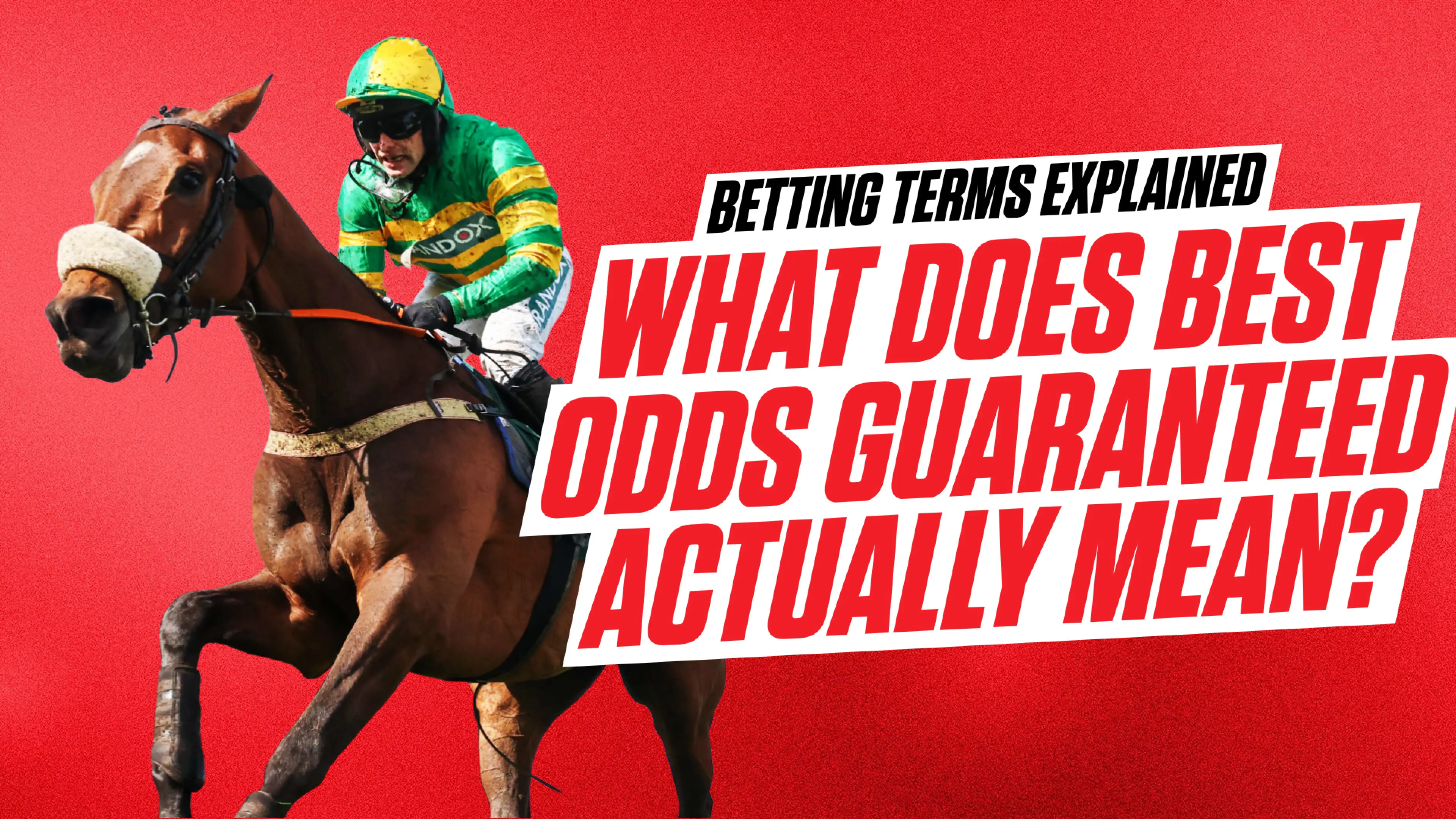

Best odds guaranteed, or BOG betting, means that if you take an early price on a horse and it starts the race at bigger odds, your bet is settled at the bigger price. If the Starting Price (SP) turns out shorter, you keep the price you took.
Odds of 4/1 mean you win £4 for every £1 you stake, plus your stake back. A price "drifts" when the odds get bigger and "shortens" when they get smaller.
You take 4/1 in the morning and the horse starts at 6/1. If it wins, your bet is settled at 6/1.
You take 4/1 in the morning and the horse starts at 3/1. If it wins, your bet is still settled at 4/1.
So with BOG, a winning bet is paid at whichever of the two prices is bigger. It changes how a winner is paid and nothing else.

The Starting Price is worked out from a sample of off-course bookmakers' prices at the moment the race starts, known as the off. "Off-course" means high-street and online bookmakers rather than the bookmakers standing at the racecourse. The Starting Price Regulatory Commission (SPRC) sets the rules. If you bet without taking a fixed price, you're paid at SP, and it's also the figure BOG checks your early price against.
For most of racing's history, the SP came from the prices offered by bookmakers at the course, in the area known as the betting ring. That changed when racing went behind closed doors in 2020. In 2021 the SPRC decided the SP would stay based mainly on off-course prices, citing Gambling Commission figures that put the on-course share of betting at about 1.4%. In 2024 the SPRC's chair put that share at about 1.5%, and on-course prices have since dropped out of the SP in Britain altogether.
To count towards the SP, a bookmaker's prices must be open to anyone in the UK, offer each-way terms based on the win price, and make up at least 1% of the UK market on British racing. Betting exchanges, where customers bet against each other rather than against a bookmaker, and the Tote, which pays out from a shared pool, don't offer each-way terms that way, so they are left out.
Bookmakers change their prices as money comes in, to avoid owing too much on any one horse:
Steady support for a well-fancied horse shortens its price.
When an outsider is well backed, it shortens too, and other runners, often the favourite, can drift to balance the book.
A withdrawal reshapes the market around the horses that are left, and can shorten them.
Late news, such as a change in the ground or a change of jockey, can move prices in the final minutes.
A price on offer five minutes before the off is not the SP. The SP is fixed at the off and published with the result, and the Racing Post lists returned SPs in its results for each race. Once the race is under way, any further betting happens in the in-play racing markets, which sit outside the SP.
An early price is set on the horse's past results, the likely runners, the expected ground and the distance, before much money has been bet. The SP shows where the money went once the day's news came in. That news includes:
Trainer comments, or a horse wearing headgear such as blinkers for the first time.
A change in the going, the official description of the ground. Overnight rain or a drying wind can change it, and the British Horseracing Authority sets the official going descriptions and requires any change on the day to be announced.
A jockey being booked or replaced.
A horse being withdrawn after it has been entered to run, including when the stewards declare it a non-runner at the start.
When a runner is withdrawn after you have taken a price, Rule 4 deductions can reduce your winnings on the horses still running, by an amount that depends on the withdrawn horse's price. The Tattersalls rules set out the exact scale.
The early price is a judgement made before racing, and the SP is a record of the market at the off. Neither is more "correct" than the other.
BOG usually applies to UK and Irish horse racing on the day of the race. You'll find which races, bet types and times qualify in the current Ladbrokes terms on the promotions page.
Some race types or meetings on horse racing can be left out of BOG, so check the terms for your race.
Early prices usually qualify from a set time on the day of the race, stated in the terms.
Antepost bets, placed days or months before the race, such as on the Grand National odds, typically sit outside BOG.
Pool betting on racing pays out a share of a pool rather than fixed odds, so there is no early price for BOG to protect.
For multiples, where several selections are combined in one bet, the terms set out how each leg is treated.
For each-way bets, the terms confirm whether the place part follows the same rule.
If your horse doesn't run, the terms explain what happens to your stake. They also explain how a Rule 4 deduction for another runner works alongside BOG.
With BOG, taking a morning price comes down to what you think of the horse, the ground and the distance, not whether the market will move your way. If the price shortens, you keep yours. If it drifts and your horse wins, you are paid at the bigger SP.
It's worth setting a budget before you start. GamCare runs the free National Gambling Helpline, and the Gambling Commission explains how operators must protect you. For form and previews before the off, browse the Ladbrokes horse racing news or the racing hub.
See today's racecards and horse racing markets at Ladbrokes.
You must be 18+ to bet, so please gamble responsibly and treat a morning price as part of the day's entertainment. The Ladbrokes safer gambling page sets out the tools and support available, and you can visit Help & Contact if you have questions about a BOG bet.